

“And now we must ask where we evangelicals have been in the battle for truth and morality in our culture…Have we even been aware that there is a battle going on – not just a heavenly battle, but a life-and-death struggle over what will happen to men and women and children in both this life and the next? If the truth of the Christian faith is in fact truth, then it stands in antithesis to the ideas and immorality of our age…Truth demands confrontation. It must be loving confrontation, but there must be confrontation nonetheless.”
Francis Schaeffer, Complete Works, Volume 4, p320.
As some readers will know, I’m currently working towards a PhD on the writings of the late Christian apologist and pastor, Francis Schaeffer (1912-84). Schaeffer wrote more than 20 books, covering all kinds of topics, and when you’re as immersed in his thought as I have to be, it’s hard for me not to ask the question, ‘What would Schaeffer be saying to us now if he were still with us?’
During these strange days when the Corona Virus dominates our lives, I think I know what he’d be saying, and it’s something that in my estimation, stands out as being his greatest contribution to Christian thought. It was this: Schaeffer saw the fundamental inability of the contemporary secular mind to make sense of the world. And he knew why; it had recklessly decided that the Bible was not true knowledge about reality, just ‘religious’ knowledge. The result is a race lost at sea without a compass or lighthouse in sight. Only with our Bibles open can we find our way home.
As we live through the Corona Virus with all its life-threatening and life-impacting implications, Christians need to take time to process what Schaeffer said if we’re to have something to say to our beleaguered world. In one sense his insight was simple, but it was also profound. I’ll come to Schaeffer later but first let me make some introductory comments about our secular age.
Speaking now of Western societies, one of the striking things about today’s generation is its seeming inability to realise that this thing called human existence is open to lots of worldview interpretations. Or to put it another way, there’s a profound lack of awareness that reality is contested; that just because everyone on our street or in our nation thinks a certain way doesn’t make it correct! The reasons for this naiveté are pretty straight-forward: (1) We live in an age where almost everything conspires to blunt serious thought (2) Our knowledge of history is often very weak (3) We moderns assume that good thought is linear and progressive, so that if we believe something that’s up to date it must be correct (4) For the most part reality is spoon-fed to us by the media. The beneficiary of these factors is the secular world and life view which today enjoys a virtual monopoly- hold on our collective minds. Secularism: the worldview that maintains that all of life can be understood, enjoyed and all its problems fixed without any need to reference to God. The measure of secularism’s triumph is such that it has subconsciously trained huge numbers to imagine that they don’t even possess a worldview; they just see the world as it is, the ‘normal’ way. And that’s the reason why today for most people in western societies, no other way of understanding the world can be imagined. You begin to realise the power of secularism when to diverge from its narrative gets you labelled as some kind of a nutter; even your sanity is in doubt.
What the popular western mind fails to realise is that the way we collectively think is little more than the sum of what a particular crop of philosophers has taught us during the last 500 years or so. If they’d been a different crop, we’d doubtless think very differently. But what’s undeniable is that when you study the philosophers who did make it into our textbooks, you find that for the most part they purposely march in a direction away from a Biblical understanding of the world. The official story is that they were following the evidence; more likely it’s because they wanted to shape a society where God was excluded, allowing Man to be the centre of all things. There is nothing inevitable or logical about the arrival of the secular society; it’s sadly just that our fallen hearts wanted it to be that way.
Although the secular project has its roots in the fulfilment of the temptation offered to Eve in the Garden of Eden, ‘You shall be as God, deciding good and evil’, arguably the defining event that shaped the modern world was the European Enlightenment (c. 1715 – 1789). In broad terms, The Enlightenment attempted a range of things: to announce that Man had come of age and finally dispensed with superstition; to deny the supernatural; to embrace a radical scepticism about everything; to replace divine revelation with human reason; to pursue a utopia created through science, technology and education. John Stott, the late British Evangelical leader often suggested that the Christian Church has never answered the Enlightenment’s claims. I think he’s right; the frequent willingness to acquiesce to its thought has been shameful and cowardly.
With all that as background, let’s come back to Francis Schaeffer. What Schaeffer realised – and explained in his book, ‘Escape from Reason’[1] – was that perhaps the most enduring legacy of the Enlightenment is that it succeeded in persuading us that knowledge should be split into two. On the one hand it maintained that there is ‘real’ knowledge, knowledge that emerges from reason and science. This is the realm of facts it declared, and forms the sphere of public knowledge, knowledge which is binding on everyone. The other type of knowledge is a far lesser type, private knowledge which is personal, preference and subjective. This lesser type of knowledge includes religion, beliefs and morality. In the end this type of knowledge falls into the category of opinion and so has no universal application.[2]
Schaeffer likened the modern world’s splitting of knowledge into two to a two-story building; he called the lower story ‘reason’ and the upper story ‘faith’:
|
Upper Story: Faith (faith knowledge) (Private truth– personal choices and private meaning; religious knowledge; realm of values/preferences/feelings; non-rational; not objective knowledge; God and religion). |
|
Lower Story: Reason (rational knowledge) (Public truth and fact; rational and verifiable; realm of science and reason/true and false; real knowledge; binding on everyone; must be submitted to. This is the ‘value free world’ and society only takes this realm seriously) |
We should note at this point that Schaeffer did not agree with these definitions of reason and faith; far from it. He was simply trying to explain how the modern world had come to evaluate life.
The relevance of this for Christians is that the Enlightenment effectively persuaded society that knowledge from the Bible is not real knowledge; based on its own definitions, it is ‘faith’ knowledge and so cannot be rational or contain truth binding on everyone. Accordingly, following its logic, knowledge from the Bible must not be allowed to intrude into the world of public thought and decision making. Instead the Christian faith is relegated to the realm of preference and experience. Moreover, and in keeping with this approach, redemptive history is reduced to the status of myth: the virgin birth, the miracles of Jesus, the salvific power of the cross, the resurrection, the future coming of Christ are all nice stories but have no truth value to shape the real world. The result is the most concerted and audacious attempt to gag God imaginable; if accepted, God’s Word is stripped of its power to speak to us. The dirty fingerprints of Satan, the father of lies, are found all over the plot.
To explain this in another way, the Enlightenment’s approach to knowledge effectively shuts down access to what we might call the inescapable questions of life; questions which will never be answered in the lower story of science and reason, by the scientist working with the assumption that all that exists is material stuff. Life throws up massive questions that simply won’t go away no matter how modern and sophisticated we think we’ve become. Here are just a few: who is God, why is the world here, why am I here, what makes life meaningful, what happens to me when I die? All these questions can never be answered by human observation and experience alone.
The necessary data to answer the great questions about life and existence comes in the form of revelation given by God in the words of Scripture. The Bible is not some irrelevant and outmoded document but is the means by which our Creator has communicated to us answers to the great questions of life. If a society chooses to reject the (true) Biblical story of creation, fall, redemption and restoration, the result will be a generation of people who are truly lost; answers to the great questions will forever elude us.
In recent days, it’s really struck me how our society is failing to make sense of the Corona Pandemic. It gets the science of the virus and seeks to limit its spread and develop a vaccine. Then, it hopes in time, the world will get back to normal and everything will carry on as before, trusting that western civilisation will ride on indefinitely into the future. But here’s the point: if the world returns to normal, we’ll have missed the theological interpretation that is staring us in the face, but we can’t see it because it can’t be accessed by the scientific method.
What if we were to insert a Creator into our worldview? In an incredible universe like ours, is that really such an unreasonable idea? And what if that Creator were supremely moral and good; wouldn’t that explain why we are wired to be moral? And what if this Creator were not silent but a speaking God, having spoken through history and through an incredible Book which bears records His words? If all that were true as Christianity very reasonably maintains, how do we read the virus then?
As a life-long student of the Bible, and as I look out at current events, I’m persuaded that this virus is a warning. To repeat what I said in a previous post, I’m not claiming to know whether this virus has been send from God to judge our wicked societies; I don’t have the perspective to make that call and in any case we need to see any action of judgement side-by-side with His love because today is still the day of mercy. However, what I think we can say is that since nothing is outside of God’s sovereignty, what’s happening in these days is not outside of His plan.
What we can say with confidence because it’s the clear teaching of Scripture is that God doesn’t allow wicked nations to carry on willy-nilly and turn a blind eye, He acts. And for that reason, an upturning of the apple cart is not only likely, it to be expected. The fact that some believers seem surprised by events and can be found praying that everything will just return to normal is a testimony to how many of us are asleep. In these days all of us would do well to spend time studying Romans 1, Luke 13:1-5 and all 22 chapters of the Book of Revelation!
So I think the least we can say is that we are living through a wake-up call; a shot across the bows to alert us to the fact that all is not well with our nations as they walk along the path of wickedness. Doubtless here some will balk at the use of the word wicked, and add, ‘But we’re not such a bad society; just look at the way this virus has brought us together and provoked numerous acts of kindness.’ And for every act of kindness we must be grateful and remember that we are made in God’s image. But these acts of kindness mustn’t blind us to our sin; let me suggest that if we fail to see the sin of our lands, we are spiritually blind and have lost all power of discernment. Here is the charge: nations like mine, so blessed in previous centuries, have turned their back on the God of life, love and truth; and in His place have embraced death, division and falsehood. No greater act of national betrayal can be imagined. So now instead of joyfully serving the Living God, for the most part we grovel at the feet of our idols, idols of money, pleasure, power and fame; on these we build our identity and self-worth. And out of our idolatry flow our sins: genocide against the unborn; greed that drives the arms trade; our pitiful attempt to redefine the holy estate of marriage; the filth that spews forth from our screens.
It’s for these reasons that from a Biblical perspective, it’s hard to avoid the conclusion that this virus is a welcome challenge to the very core of the secular project. The fact is that in front of our very eyes our gods are failing. Money cannot buy us a solution and in any case our economy is heading for meltdown; our celebrities are finally lost for words as the richer ones escape to their yachts to isolate; identity politics is now irrelevant, the virus cares nothing for whether you’re male or female or which letter of LGBTQ that you ascribe to yourself; governments cannot fix the problem. The point is that things have dominated our world, things that we’ve trusted in, are coming unglued. And isn’t much of that to be welcomed? Shouldn’t we be grateful that Hollywood will be unable to churn out another 700 films this year to keep us brainwashed and sedated; that children are being forced to spend more time with their mothers and fathers; that we’re being encouraged to look out for our vulnerable neighbour? There’s plenty to be grateful for.
What gives us this interpretation of the world? The Word of the Living God with its remarkable narrative of The Triune God, creation, fall and redemption and coming restoration. The Bible gives us the ability to step outside the current madness and read the world differently, with sanity and with hope. The simple fact is that you cannot understand the times in a science laboratory or in a philosophy university department where the first assumption is that all that exists is the Secular Trinity of matter, time and chance. What Schaeffer saw so clearly was that without Scripture we live blind. As I look out at our world and listen to the news, I’m reminded how up-to-date Scripture is in these days. In the midst of our troubles it reminds us that the secular kingdom will end in a nightmare, but wonderfully it also invites us into another kingdom, an everlasting kingdom, with Christ as its King. The simple fact is that atheistic secularism is in the end an empty worldview; it’s a nothing worldview; a worldview void of answers or hope. And so the need for the church to call men and women to collective repentance and a return to the living God has never been greater. I invite you to join me in these days to pray for a second Evangelical Awakening.
Since we began with Schaeffer, it’s fitting that we let him have the final word. Here’s how he concludes his book, How Should We Then Live?
“This book is written in the hope that this generation may turn from the greatest act of wickedness, the placing of any created thing in the place of the Creator, and that this generation may get its feet out of the paths of death and may live”.
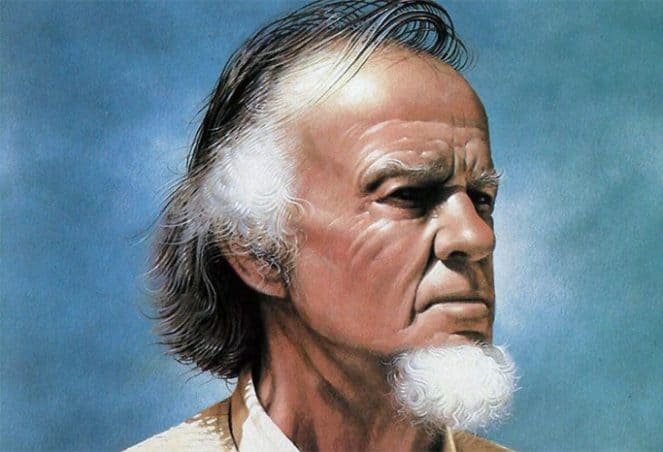
Image: https://servantsofgrace.org/wp-content/uploads/2018/03/sch.jpg
[1] Escape from Reason is not Schaeffer’s easiest book. For those who want to read the man himself, I suggest beginning with his insightful writings on the church, The Church at the End of the Twentieth Century/ The Church Before the Watching World before moving onto Death in the City which is an analysis of modern societies and their lostness. After that read True Spirituality. Then begin on his more philosophical writings: Escape from Reason, The God who is There and He is There and He is Not Silent. As an introduction to orientate yourself to Schaeffer as a man and his thought, I’d highly recommend the little biography by Mostyn Roberts, Bitesize Biographies: Francis Schaeffer. It is really excellent.
[2] Schaeffer was drawing on the thinking of Immanuel Kant with his division of knowledge into the noumenal and phenomenal.
First published on Challenging Thinking on 2020-04-01. Reproduced here in the CWT essay archive without style or semantic changes.